


If you have been thinking about moving your restaurant to a 13-period calendar, four-week periods instead of calendar months, you may have picked January 1 as the day to start. That is a natural plan.
Then the holidays arrive, the schedule fills up, and the switch slides to next year. It does not have to. A new calendar can start on the first day of any pay week, in any month, because the calendar you run the restaurant on and the calendar your bank and tax return use can sit side by side.
This post answers two questions owners ask: can we switch in the middle of the year, and what happens when we do? It walks through the switch in time order, from about six weeks before your first day to your first full quarter. Each step says who does the work and what goes wrong if it gets skipped.
Start with what already works. Your fiscal calendar is the calendar-month version of your books: January, February, March and so on. Your bank, your lender, and your tax return all use it, and plenty of restaurants run well on it. If the numbers only reach you once a month and no weekly decision depends on them, you can reasonably wait. DishBooks supports calendar months as well as every ops calendar, so nothing here says months are wrong.
The ops calendar, short for operating calendar, is a second accounting calendar that sits on the same books. It cuts the year into periods made of whole weeks, so every period starts and ends on the same day of the week. The simplest version is 13 periods of four weeks each, 52 weeks in all. Every period has the same number of days, weekends, and payroll runs, so one period compares fairly with the next. Our LinkedIn article, Your Restaurant's Calendar Could Be Lying to Your P&L, makes the longer case.
Because both calendars sit on the same books, switching does not replace anything. In DishBooks, each location keeps a fiscal calendar and an ops calendar side by side (see multi-location reporting if you run a group), and the same report flips between the two with no second set of books. The bank still gets months, the tax return still gets the year, and you get periods for running the restaurant.
A note for accountants: the transactions, the chart of accounts, and the tax year stay as they are. What changes is how the same transactions are grouped in the reports you send.
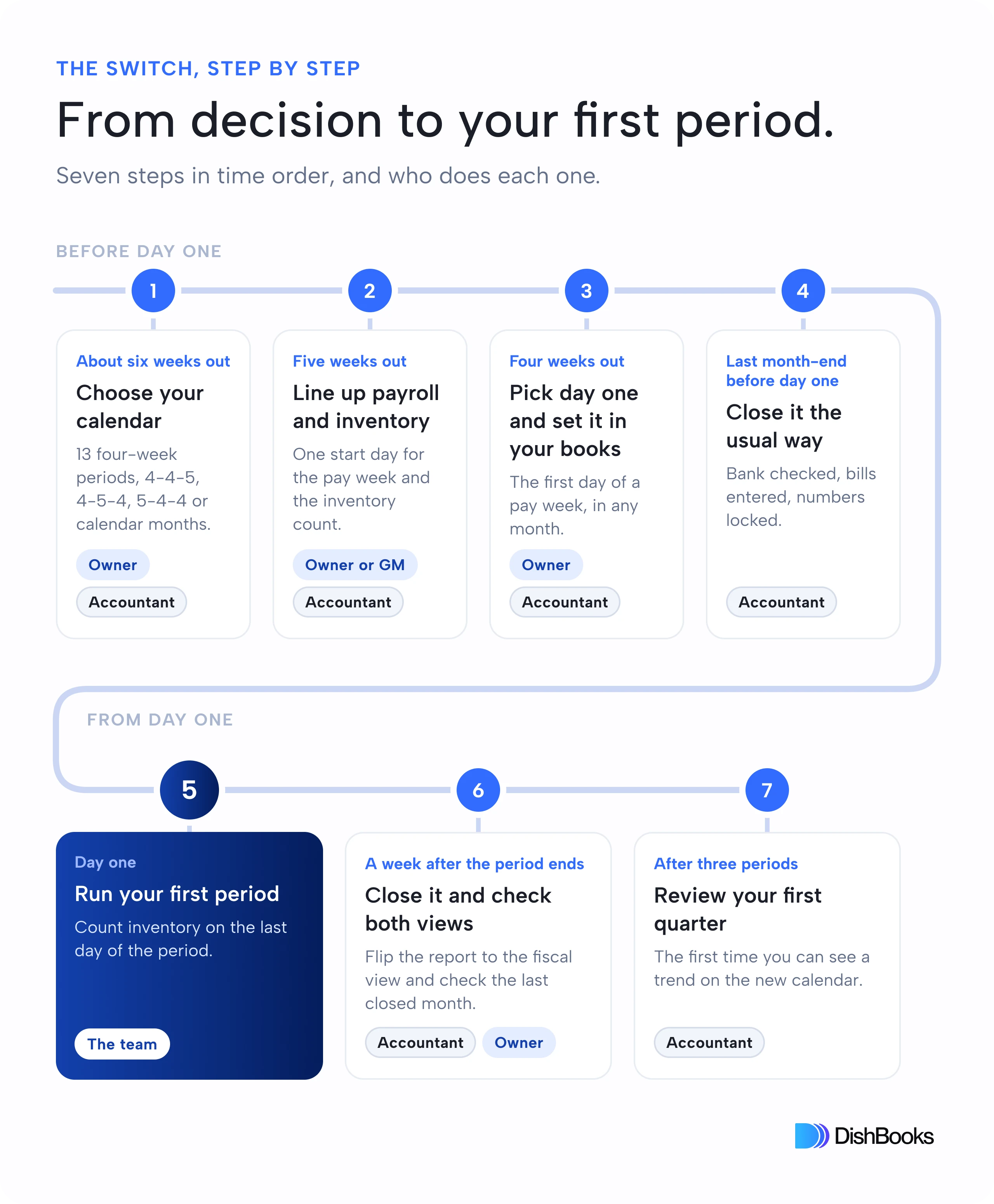
Count back from day one, the first day of your first period. The timeline has seven steps, and the first four happen before you start.
About six weeks out: choose your calendar. The owner decides, with the accountant. Thirteen four-week periods is the simplest to explain. It does not split into four equal quarters, though. Most restaurants on it group the periods three, three, three, and four. If you report to partners or lenders by quarter, 4-4-5, 4-5-4, or 5-4-4 may fit better. These use 12 periods, and each quarter has one five-week period. The numbers are the weeks in each of the quarter's three periods, so 4-4-5 is four weeks, four weeks, then five, and every quarter is exactly 13 weeks. Staying on calendar months is also a real choice, and in that case you can stop here. Settle this first. The start date and the setup both depend on this choice.
Five weeks out: line up payroll and inventory. Find two days: the day your pay week starts and the day you count inventory. Labor and food and drink costs, the two pieces of prime cost, follow those days, so a period only lines up with your sales when both share one start day and one end day. Say you count on Fridays and your pay week ends on Sunday. Every period then ends two days after its last count, and two days of food and drink costs slide into the next period. Pick one day and move the other to match. Either can move. The owner or GM and the accountant sort this out together.
Four weeks out: pick day one and set it in your books. Day one should be the first day of a pay week, and ideally of your sales week too, so a period's sales and payroll cover the same days. Any pay week in any month works, so the start can be next month and not next January. The owner picks the date and writes it down. Without one, payroll, inventory counts, and the books each start on a different day. The accountant then enters the calendar and the start date in the accounting software. If you can, choose the first pay week that starts in a month, because that keeps the leftover days at the start short. The next section explains why. If the books are in QuickBooks Online or Xero, plan time for this step. Groups on them usually set up the periods by hand or with add-ons. A skilled bookkeeper can make that work. It takes setup, and it takes upkeep every period. In DishBooks, the calendar is a setting.
At the last month-end before day one: close it the usual way. Closing a month means checking the bank against the books, entering the bills, and locking the numbers, so the month's report is final. The accountant does it the way they always have. Everything before day one stays in the fiscal calendar, reported by month, exactly as it was. A month closed with loose ends hands those loose ends to your first period, and you spend it cleaning up the old month instead of learning the new calendar.
On day one: run your first period. At the restaurant, nothing looks different. The pay week starts, service runs, and on the last day of the period the team counts inventory. The books gather everything by the date it happened. Count on the same day every period. A count taken a few days early or late pushes those days of costs into the wrong period.
A week after the period ends: close it and check both views. The accountant closes the first period the usual way and pulls the ops report. Then flip the same report to the fiscal view and look at the last month you closed before the switch. It should read the way it did when you closed it. If it does not, you have found a problem while it is still small. The owner reads the period report next, and our post on how to read a restaurant P&L, line by line walks through it. The report has nothing to compare against yet, and that is normal. The comparison starts with period two.
After three periods: review your first quarter. With 4-4-5, 4-5-4, or 5-4-4, a quarter is three periods and 13 weeks, so the accountant closes the first full quarter on the new calendar. With 13 four-week periods, the quarters are not equal, so review the first three periods together instead. Either way, this is the first time the owner can see a trend on the new calendar, not just one period against the last.
Say your last full calendar-month close is March, and March 31 fell on a Wednesday. Your pay week starts on Mondays, so day one is Monday, April 5. That leaves four days, April 1 to 4, between your last close and your first period.
They are not lost. In the fiscal calendar, they are April days, and April is reported by month like any other. In the ops calendar, they sit before day one, so they belong to no period. Period one runs April 5 to May 2. Period two runs May 3 to May 30.
Start in the first pay week of a month, as the setup step suggests, and the leftover stretch is never longer than six days.
Last year was reported by month, and a period does not line up with a month. Period one runs from April 5 to May 2, across two months, so you cannot hold it up against last April.
This year to date works the same way. In the fiscal calendar, it still runs from January through the latest month, as it always did. In the ops calendar, it starts counting at day one.
Two comparisons work from the start. Compare each period with the one before it, beginning with period two. And compare month with month in the fiscal calendar, as long as last year's numbers are in your books. A year after day one, each period also compares with the same period a year earlier.
In DishBooks, you do not have to wait a year for that. Last year, and this year before day one, can be re-cut into periods, so period one compares with the same four weeks a year earlier from the start.

DishBooks is AI-powered accounting software for restaurants, and the calendar is built in. In the ops calendar setting, you choose 13 four-week periods, 4-4-5, 4-5-4, 5-4-4, or calendar months, and you choose the start date. Each location keeps its fiscal calendar and its ops calendar side by side, so the bank still gets months while you run the restaurant on periods.
Which day of the week should a 13-period calendar start on?
The day your pay week starts, with inventory counted on the matching last day. A restaurant whose pay week runs Monday through Sunday starts its periods on a Monday. One whose pay week runs Thursday through Wednesday starts on a Thursday. What matters is that payroll, inventory counts, and periods share one start day.
Does a holiday week throw off a period?
A holiday lands in whichever period holds its date, and you read that period knowing it was there, the same way you would read a month. What the calendar does is keep every period the same length, so a holiday is not also making one period longer than the rest.
Do I need to tell my bank or lender about the switch?
The switch does not change what they receive, because your fiscal calendar keeps reporting by month. If a loan agreement says how you must report, follow that and send the view it asks for.
What happens to the extra day each year?
Thirteen four-week periods add up to 364 days, one day short of a year, or two in a leap year. Those days add up, so about every five or six years the calendar needs a 53rd week to catch up, usually added to the last period of that year. Your accountant plans for it when the calendar is set up, and the fiscal calendar is not affected.
