


Prime cost is a restaurant's cost of goods sold plus its total labor cost, measured against net sales. It's one of the first numbers an operator learns to watch, and one of the easiest to get wrong without realizing it.
Two operators can run the identical formula on the identical week and land on numbers a few points apart, not because one restaurant is run better than the other, but because one of them is measuring an input wrong. This is the walkthrough for getting the number right: the formula, a full worked example, and the 3 places the calculation goes wrong even for careful operators.
It's called prime cost because these are the 2 cost categories closest to the moment of service, the ones a manager can move week to week by changing a portion, a schedule, or a vendor. Rent, insurance, and the loan on the walk-in do not move with tonight's covers, so they sit outside the number entirely.
Prime Cost % = (COGS + Labor Cost) ÷ Net Sales × 100
That formula is 3 inputs and one division. Every mistake in this blog comes from one of those 3 inputs being measured a little bit wrong.
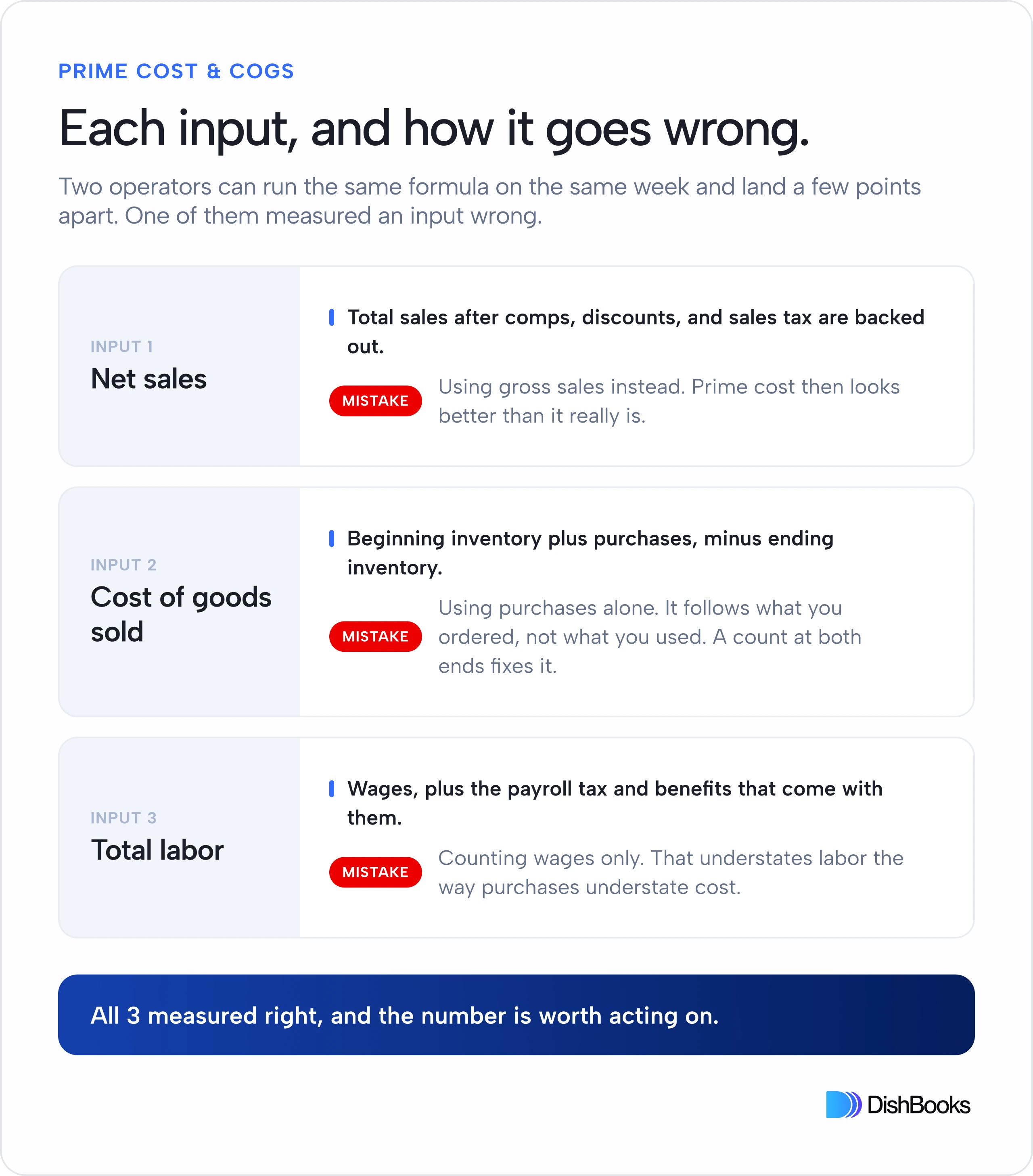
Net sales is total sales minus comps, discounts, voided or refunded transactions, and any sales tax collected on behalf of the state. Gross sales is everything that rang on the register before those subtractions. Using gross sales in the denominator makes prime cost look better than it is, because the top of the fraction stays the same while the bottom gets padded with money the restaurant never kept.
Cost of goods sold is beginning inventory, plus purchases during the period, minus ending inventory. Purchases alone is a different number. It measures what came in the back door, not what left the kitchen and went out to a table. Skip the inventory count on either end, and what you have is a purchasing number, not a usage one.
Labor for this formula means gross wages for the people working that location day to day, front and back of house, plus the payroll taxes and benefits load that comes with employing them. It does not include a corporate salary or an owner's draw that has nothing to do with running the floor that week. That distinction is exactly why it is called prime labor and not total labor.
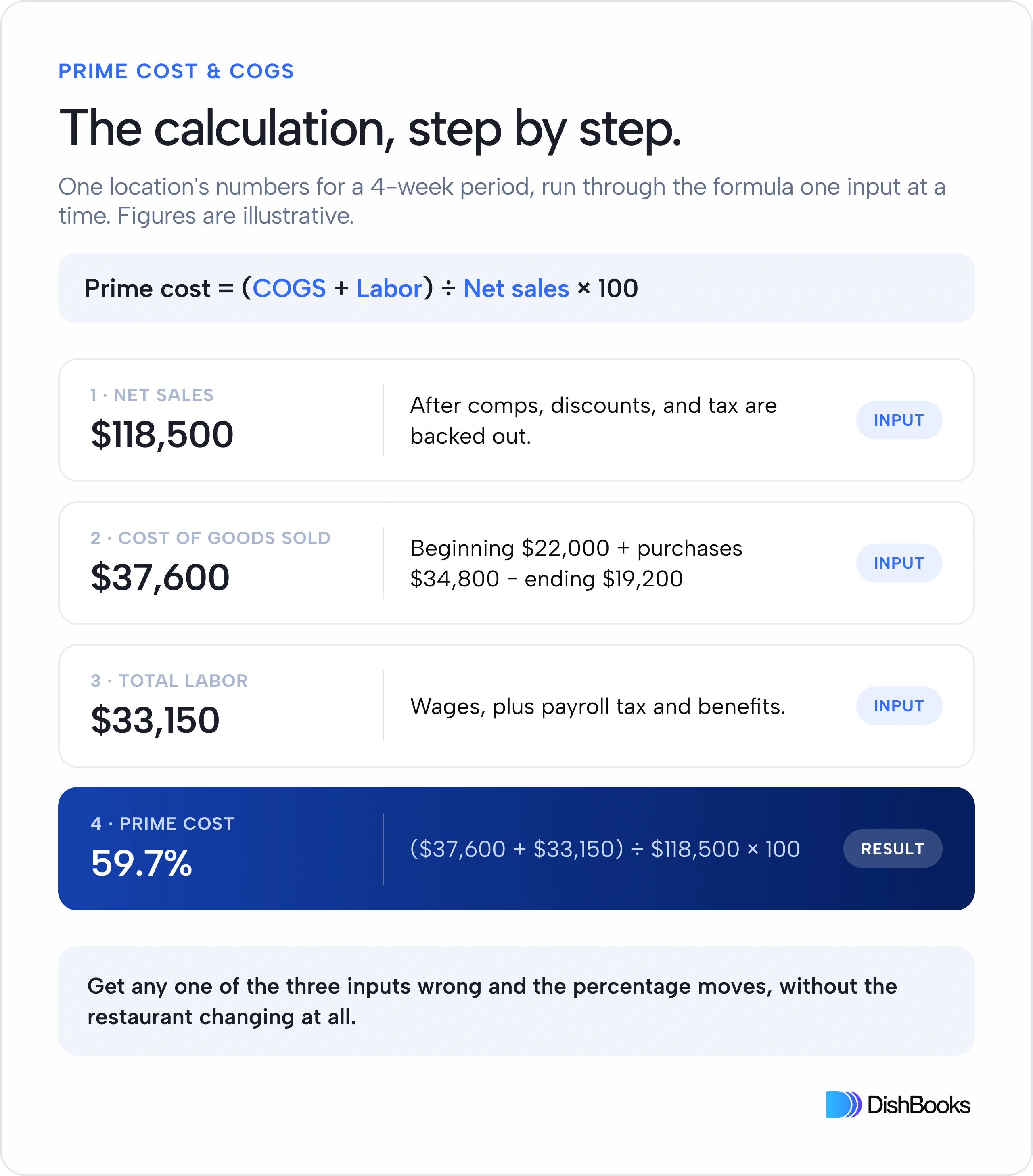
Here is the formula running on one location's numbers for a 4-week period. The figures are illustrative only, built to show the mechanics, not a claim about what any real restaurant's numbers should be.
Cost of goods sold of $37,600 plus total labor of $33,150, against $118,500 in net sales, puts that location at 59.7%. Every one of those numbers had to be measured correctly for the percentage to mean anything, and getting any one of the 3 inputs wrong moves it without the restaurant changing at all.
Every mistake above compounds across locations, because a blended prime cost for a 3-unit group tells you even less than a wrong number for one location does. If unit 2 is carrying the whole group's prime cost up 2 points while units 1 and 3 are steady, a single combined figure hides exactly the thing an operator most needs to see: which location needs attention this week.
None of the 3 mistakes above need new software to fix. They need a consistent process, applied the same way every period:
That last point is where most of the manual work lives, and it's the one a fiscal calendar solves permanently instead of period by period.
DishBooks is AI-powered accounting software for restaurants. Prime cost is a headline on the dashboard, not a spreadsheet rebuilt from scratch every period.
Is there one ideal prime cost percentage every restaurant should target?
No single number applies across concepts. A quick-service counter, a full-service dining room, and a bar program carry different cost structures by design, and even two restaurants in the same category can run healthy operations at different prime costs depending on price point, service model, and market. The more useful habit is tracking your own number on a consistent, correctly measured basis and watching the trend, rather than chasing a figure that came from a different kind of restaurant entirely. Your accountant can help set a target specific to your concept.
Does prime cost include rent or utilities?
No. Occupancy costs, insurance, and other fixed overhead sit outside prime cost on purpose. That is the entire reason it is called prime cost rather than total cost: it isolates the 2 categories a manager can influence shift to shift.
How often should I actually calculate it?
Weekly is the operational goal, since that is often enough to catch a problem while it is still cheap to fix. Monthly is the minimum. The reason most restaurants land on monthly anyway is not that weekly doesn't matter, but that rebuilding the calculation by hand every week is not realistic on top of running service.
Does labor mean just wages, or does it include payroll tax and benefits too?
The full labor burden, wages plus payroll tax plus benefits. Leaving out the burden is mistake 2's close cousin: it understates the labor side of the formula the same way purchases-as-COGS understates the cost side.
Prime cost is COGS plus labor over net sales, and every mistake in calculating it traces back to one of those 3 inputs being measured a little bit off: gross sales instead of net, purchases instead of true cost of goods sold, or a comparison across periods that were never on equal footing to begin with. Get those 3 things right once, and the number finally means what it's supposed to mean.
If you haven't already, the previous blog walks through what AI actually does and doesn't do in restaurant accounting, including how a system like this one keeps a number like prime cost current without anyone rebuilding it by hand.
