

Blog
/
Technology & AI

AI in restaurant accounting: what it actually does

September 16, 2026
Jordan Carbia
Head of Growth & Development

Key Takeaways
  • AI means 3 things: rules relabeled, pattern recognition, language models. Not equally reliable.
  • AI does 3 jobs well: reading documents, grouping costs into real categories, explaining what changed.
  • 3 jobs still need a person: approving spend, verifying a reconciliation, deciding on a variance.
  • The test for any AI feature: when it gets something wrong, who finds out, and when?
Jump to a section

Every accounting vendor selling to restaurants now says the product has AI. Few say what it touches, and some are describing a feature that has been in accounting software for years under a different name.

That vagueness is a problem for an operator trying to choose. When two products both say "AI-powered" and neither says what the AI actually does, price becomes the only thing left to compare.

So here is the specific version. There are jobs in restaurant accounting that AI does well, and there are jobs it should not be allowed near. The second list matters more than the first, because a vendor willing to name the limits is telling you they understand what they built.

What different accounting software usually means when they say "AI"

The same label covers 3 quite different things.

  • Rules, relabeled. If the vendor name matches, code the invoice to this account. That is a rule, not intelligence. Rules are useful, and they have been in accounting software for 20 years, but they break the moment a vendor changes their invoice layout.
  • Pattern recognition. The software reads a document it has not seen before, recognizes the structure, pulls out the fields, and proposes a coding based on how similar documents were handled previously. This is newer, and useful in ways the old rules never were.
  • Language models. The software reads your numbers and answers a question about them in a sentence instead of a spreadsheet. This is the part that changed recently.
When a vendor says AI, ask which one they mean. The answer tells you a lot.

The 3 jobs AI genuinely does well

Reading documents and proposing where they belong

Restaurants generate an unusual volume of paper for their size. A single location taking 3 deliveries a week from 20 vendors is looking at roughly 240 invoices in a 4-week period. At 3 locations, the number stops being something one person can keep up with alongside everything else the week demands.

Pattern recognition handles this well. The software reads the invoice, extracts the totals and the line items, and proposes where each one belongs based on how that vendor was coded before. Proposes is the operative word, and we will come back to it.

Grouping costs into categories that mean something

A single blended COGS number tells you that something moved. It does not tell you what. Split the same spend into protein, dairy, produce, beverage, and paper goods, and the number starts pointing somewhere.

This kind of consistent categorization across thousands of line items is exactly the sort of work software does better than people, not because it is smarter, but because it does not get tired at invoice 180 and start putting things in the nearest available bucket.

Explaining what changed between periods

Finding a variance is not the hard part. A spreadsheet finds variances. The useful part is the sentence that explains it: protein COGS rose 2 points this period, and most of the movement traces to one vendor raising the price on an item you buy every week.

That is where language models earn their place. They turn a number into something you can raise in a manager meeting on Tuesday morning without spending Monday night building the explanation yourself. The same holds when labor runs high, or when a vendor raises the price on something you buy every week, and nobody notices right away.

The 3 jobs that still need a person

This is the list that tells you whether an accounting software has thought the problem through.
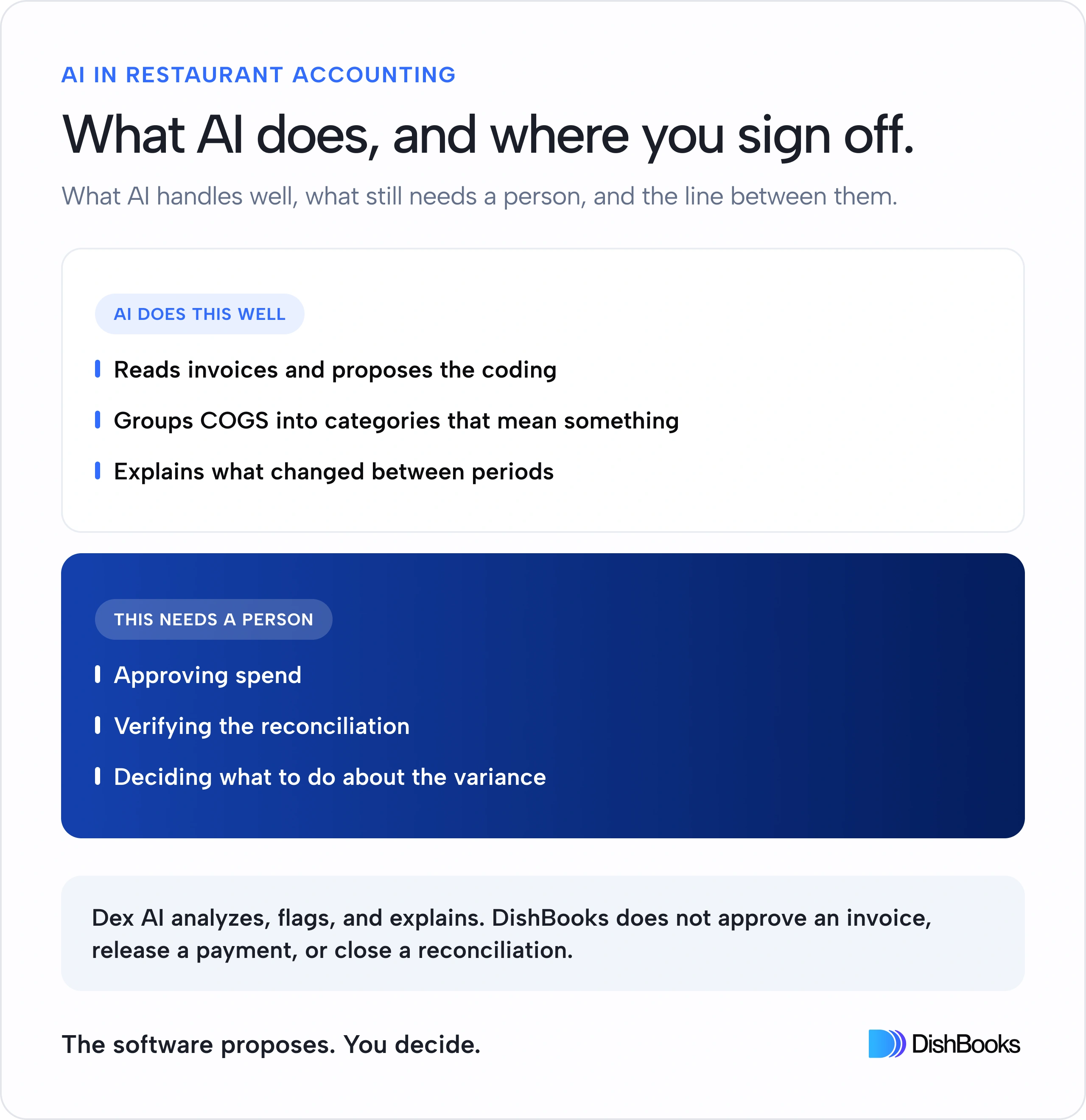
  • Approving spend. No model should release money. Approval is a control, and a control that a machine can satisfy on its own is not a control. In software that takes that seriously, approval is a named permission held by a named person, not a preference buried in a settings page.
  • Verifying a reconciliation. Software can suggest which transactions match. A person confirms it, because that confirmation is what your accountant, your lender, and eventually an auditor are relying on. A suggested match that nobody checked is not a reconciliation. It is a guess with good formatting.
  • Deciding what to do about the variance. Knowing protein is up 2 points is analysis. Deciding whether to renegotiate with the vendor, change the spec, switch suppliers, or absorb it for a quarter is a judgment about your guests, your market, and your positioning. No model has that context, and the ones that pretend to are guessing.
Two cards side by side. The left card, headed "AI does this well," lists reading invoices and proposing the coding, grouping COGS into categories, and explaining what changed between periods. The right card, headed "This needs a person," lists approving spend, verifying the reconciliation, and deciding what to do about it. A line below reads: the software proposes, you decide.

Why restaurant accounting suits this better than most industries

Restaurants happen to have 3 characteristics that make this kind of software work unusually well.

  1. Volume with repetition. The same vendors deliver the same items week after week. That repetition is what pattern recognition needs. A business with 12 invoices a month and no two alike gives the software almost nothing to learn from. A restaurant gives it hundreds of near-identical examples.
  2. Categories that carry real meaning. In most industries, cost categories are an accounting formality. In a restaurant, protein behaving differently from paper goods is a diagnostic. The categories map onto decisions you actually make.
  3. Periods that repeat cleanly. Restaurants that run an operational calendar get periods built to be compared. On a 13-period calendar every period carries the same number of days and the same number of weekends, so two of them sit side by side honestly. Compare a February with 5 weekends against one with 4, and the variance you produce is mostly calendar. Software explaining that variance is explaining noise, very fluently.

That third point is worth sitting with. The quality of any explanation depends entirely on whether the two periods being compared were ever comparable.

2 questions to ask a partner who says their product has AI

  1. What specifically does it touch? Invoices? Reconciliation? Reporting? All 3? "The platform" is not an answer.
  2. Does it act, or does it propose? If anything happens without a person confirming it, ask what the process is when it gets something wrong.
A partner who answers both questions plainly is worth a second conversation. A partner who answers them vaguely does not.

How DishBooks draws the line

DishBooks is AI-powered accounting software for restaurants. Dex AI is the financial assistant built into it.

Dex analyzes, flags, and explains. It does not act on its own. Ask it about a movement in your numbers and it gives you an explanation. DishBooks does not approve an invoice, release a payment, or close a reconciliation.

In practice that means:

  • Reconciliation matches are AI-suggested. A person verifies each one before it stands.
  • Invoice approval runs behind your approval rules, not behind a model. A bill moves through named states, waiting for review, then waiting for approval, then approved, and a person puts their name to each of the last two.
  • COGS breaks out by category, protein, dairy, produce, beverage, and paper goods, so a movement points somewhere specific rather than at the total. Prime cost sits above those categories in the chart of accounts, food cost and labor read together.
  • Reporting runs on your calendar, not ours. Each location keeps a fiscal calendar and an operational calendar side by side, and a report can be grouped by period, quarter or year in either one, whether that calendar is 13 periods, 4-4-5 quarters, or a standard 12 months.
  • Access is set per person, per report. A role can be given nothing, a view, full control, or the right to approve, so who signs off on what is a decision the restaurant makes rather than a default the software ships with.

That is the pattern behind every decision above: AI reads the numbers, a person decides what to do about them, and DishBooks is built around keeping that split clear rather than blurring it.
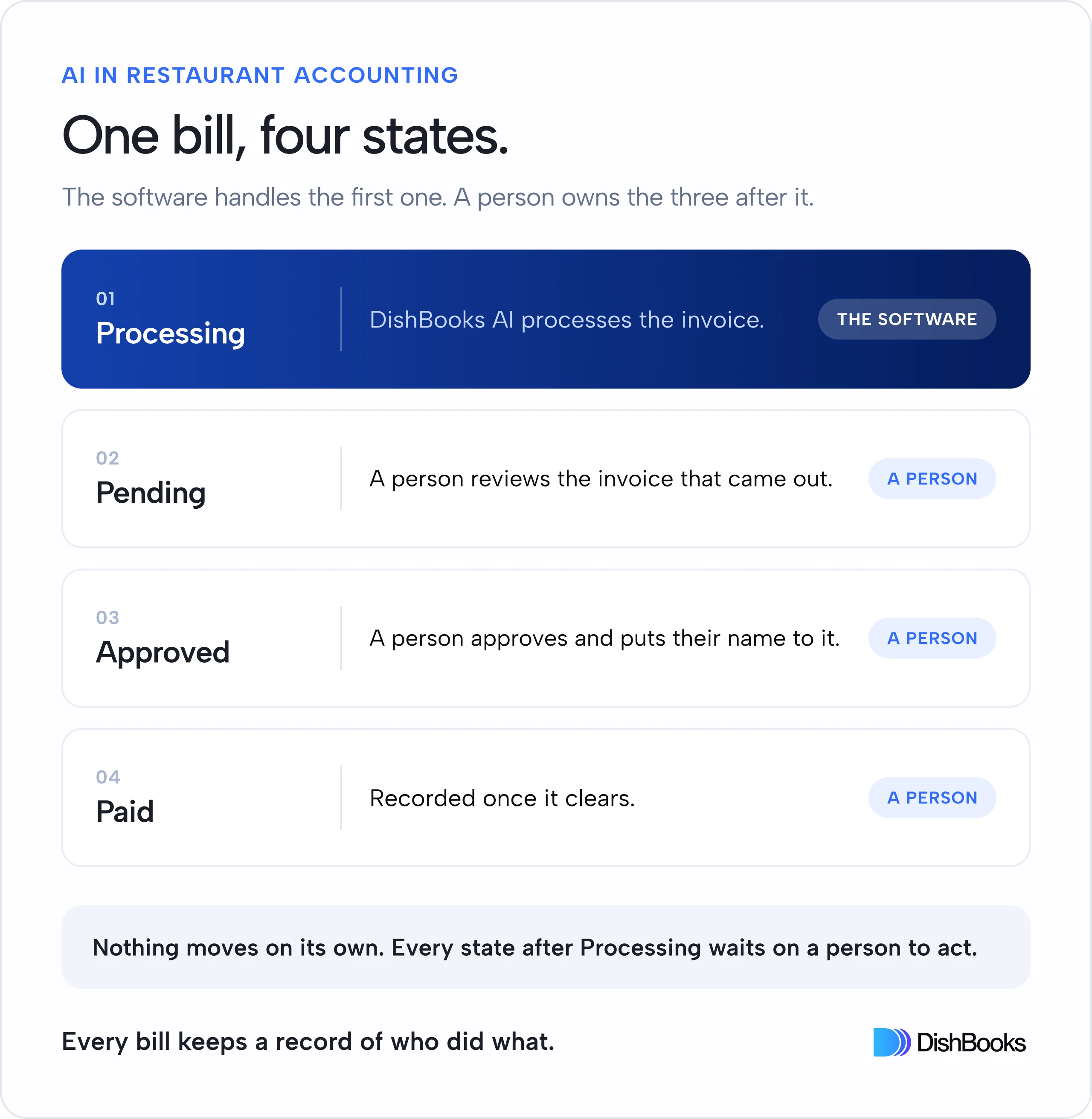
Five cards tracing one bill through processing, pending, draft, approved and paid, the first marked the software, the four after it marked a person.

Frequently asked questions

Will AI replace my bookkeeper or accountant?

No. It changes what they spend their hours on. Coding invoices and chasing matches is the part software handles well. Interpreting the result, planning around it, and signing off on it is the part that needs a person, and that is the part worth paying for. For a firm working with restaurant clients, the software moves those hours from data entry toward advisory work.

Is AI accounting accurate enough to trust?

The more useful question is whether it is checkable. Software that proposes an answer and shows what it based that answer on can be verified in seconds. Software that acts in the background and leaves nothing to check cannot be verified at all. Ask for the first kind.

Can AI give me a real-time profit and loss statement?

No, and be careful with anyone who says otherwise. Sales from a point-of-sale system can be current. A P&L also depends on payroll, which lands on a pay cycle, and on invoices that may not have arrived yet. What you can reasonably have is a current view of sales and an accurate P&L on a predictable cadence.

Do I need to change my accounting calendar to use software like this?

No. Software worth using holds your fiscal calendar and your operational calendar at the same time, whether that operational calendar is 13 periods, 4-4-5 quarters, or standard months. The comparisons do get more useful on a period calendar: every period carries the same number of days and the same number of weekends, so a variance between two periods reflects the business rather than the calendar.

The short version

AI in restaurant accounting is not one thing, and "AI-powered" on its own tells you nothing at all. What tells you something is a vendor willing to name two things: the jobs their software does and the jobs it leaves to you, plus the exact point where a person has to put their name to something.

Those are the lists worth asking for. A vendor who cannot produce the second one has not thought hard enough about what they built.